Hollow Knight: Silksong
7.8/10B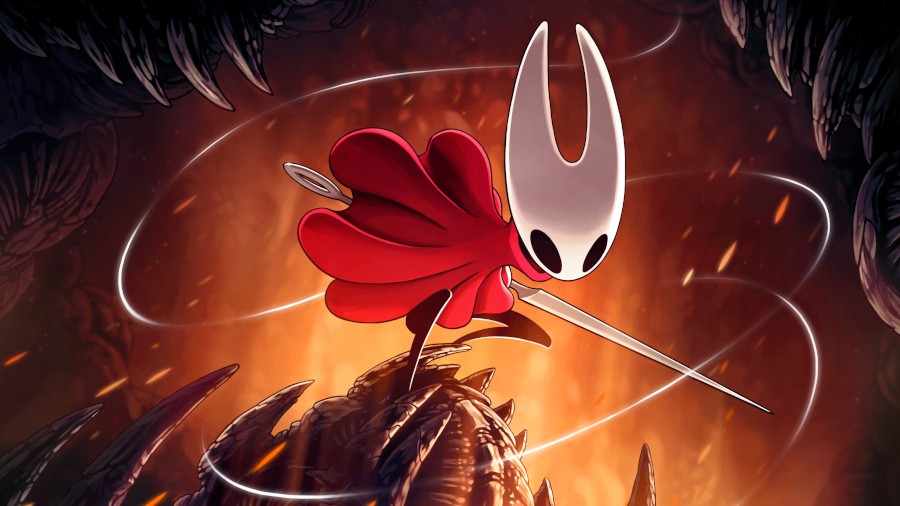
Warning
This article contains spoilers for the following topics: Hollow Knight: Silksong Acts 1-3
Hollow Knight: Silksong has released after nine years of development and I've finally gotten around to playing and finishing the game! I played both Hollow Knight and Silksong for the first time back-to-back on stream and it was such a memorable experience. It was absolutely thrilling to discover new areas and find charms, tools, and bosses for the first time. It's given me a better understanding of Silksong both as a standalone game and as a sequel. Silksong is an upgrade to the original Hollow Knight in many ways and will hold a special place in my heart, but I have slightly mixed feelings about the game as a whole even if I absolutely loved it. Here is my review of Hollow Knight: Silksong.
If you'd prefer to watch someone play the game instead, I totally get it. I live-streamed the entirety of my first playthrough and have all the recordings available to watch. I've also linked a lot of relevant points in my streams in this review to reference for your convenience.
Plot
The main playable character in Silksong is Hornet, a half-Weaver (spider) who appeared as an NPC in the first game. The game's story is broken into three distinct acts:
- In Act 1: Pharloom, Hornet is mysteriously captured against her will and brought to Pharloom, where she must regain her strength and identify her captor. As the game progresses, we learn that her captor is a silk weaver that has been gradually taking over Pharloom and its inhabitants' minds. Hornet ascends the areas of Pharloom to reach its Citadel where she hopes to confront her captor.
- In Act 2: Citadel of Song, Hornet explores Pharloom's citadel and learns its threefold melody to reach the top tower and defeat her captor, Grand Mother Silk.
- In Act 3: Abyss, we learn that the Snail Shamans' trap for Grand Mother Silk backfired. Hornet must hurry and gather hearts from the old kingdoms to gain the power to dive into the abyss and save Pharloom from being consumed by the void.
I appreciate that Silksong's plot is easy enough to follow without watching lore videos (unlike the first game). The player is given an explicit objective menu screen with map markers as a guide for the story. There's never a point in the game where the goal is unknown. The plot is always pushing the main character up to ascend the city and reach the tallest tower (when in doubt, go up). To emphasize this point, the first checkpoint in the game is called "Bone Bottom" and located at the bottom of the map.
World and Atmosphere
Silksong's atmosphere is immersive. Every area in the game is filled with beautiful orchestral music and a general ambience in the form of particle effects and animations of water, wind, and flames. There's so many great characters and companions in every area. Each area in Pharloom tells a unique story of what kinds of bugs live there and how the citadel and its silken monarch affect their lands.
Visuals
Every map area of Silksong has phenomenal visuals. Similar to Elden Ring, each area uses its own unique color palette that makes finding and exploring new areas an absolute joy.
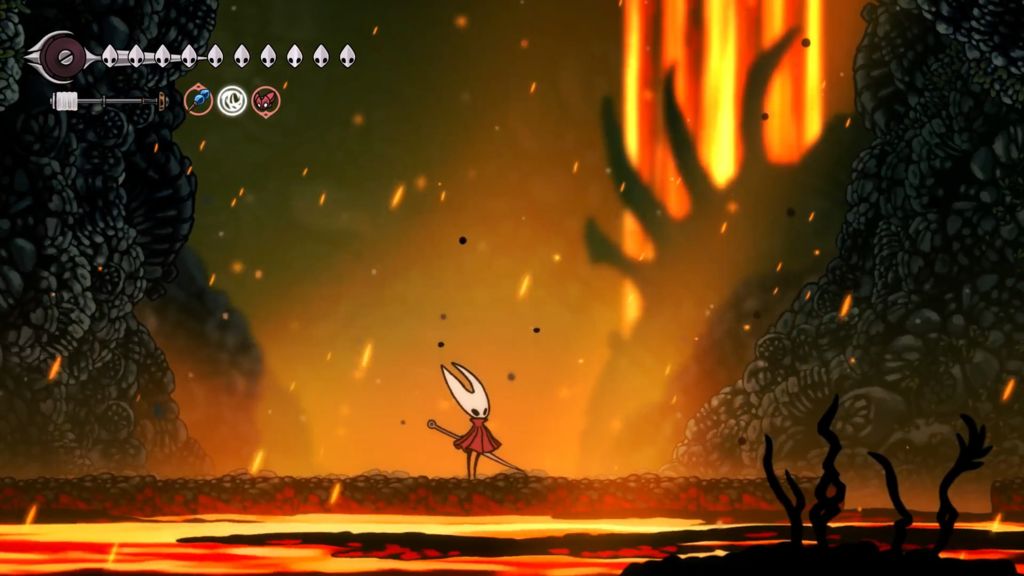
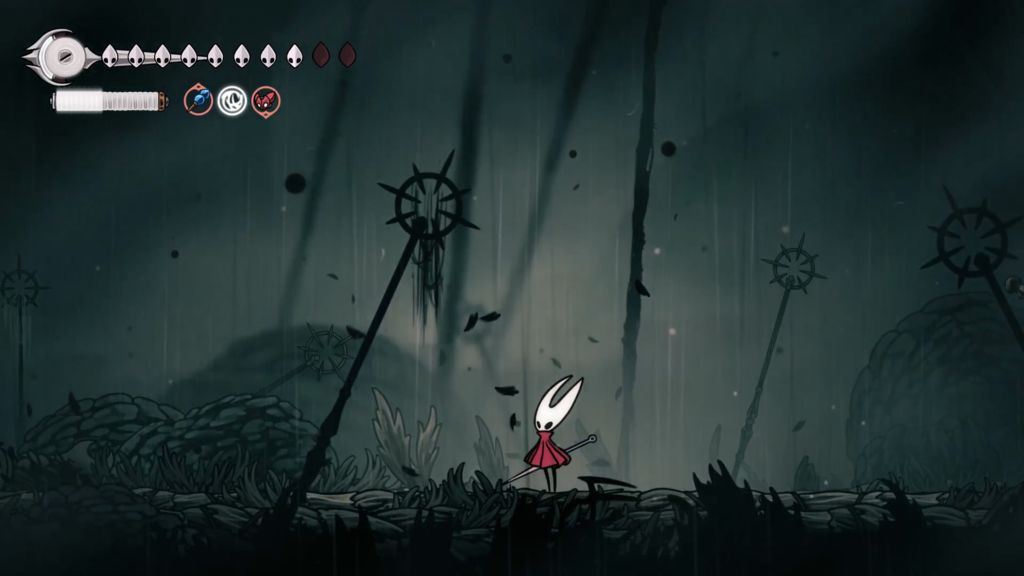
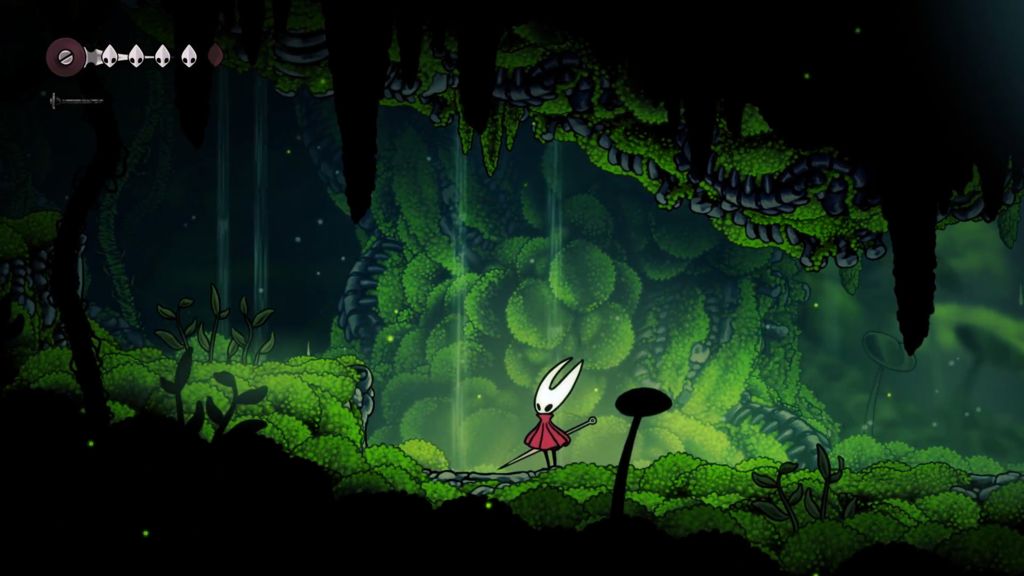
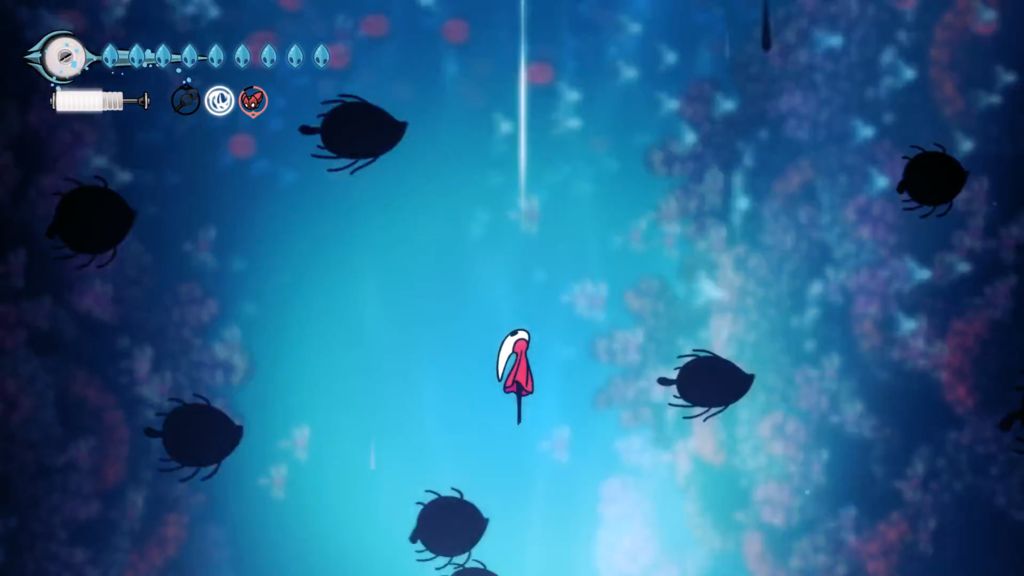
Every single area is infused with detail: from the parallax background[1], to the floor, to the walls, to inanimate objects. Most inanimate objects you encounter as Hornet are interactive and not just part of the background. As Hornet, you can cut grass, break rocks, ring bells, tear curtains, and even rip pillows. It gives you the impression you're actually living in the world:
Hornet's character model is no exception. Every movement Hornet makes has a unique animation that varies depending on if she walks or runs. It's a huge improvement from Hollow Knight where the player character model has very little animation outside of attacks. It makes Hornet feel fluid and more life-like than the knight.
Her cloak even gets blown upwards when she stands over an updraft. It's such an unnecessary detail to add to the game, but the fact that Team Cherry took the time to include it further speaks to their committment to authenticity:
Likewise, there are visual details embedded in the environment that add to realism of the world. For example, birds in the background fly away every time Hornet walks through Greymoor. Ants will pick up items and bodies you leave behind in Hunter's March. Enemies in the background will come to the foreground when fighting in most gauntlets[2]. The ground will sometimes even move when Hornet steps on it. The level of attention to the environment in this game is truly immaculate.
Music
The quality of music in Silksong surpasses even its visuals. Each area contains a beautiful background melody composed of piano and stringed instruments. Listen to the music for the first rest area, "Bone Bottom". It sounds both sad and hopeful, representing the worn state of the village and the beginning of the pilgrims' journey up to the citadel:
Source"Blasted Steps" plays in the final area leading up to the citadel, representing the final climb in a pilgrim's journey before reaching their goal. The emphasized drawn-out notes in the melody combined with the bass elicit a sense of finality and importance as you climb the rock faces to reach the grand gate.
SourceAnother beautiful track is "Choral Chambers". It evokes a sense of the majesty and splendor of the grand halls of the citadel. You can hear echoing in the song to represent the vastness of the citadel's halls. Exploring this area for the first time was an experience I'll never forget:
SourceIf that's not enough, just listen to one of the last tracks in the game when Hornet makes her final descent to save the whole world and Lace with it. It sounds simultaneously tragic (reflecting Lace's current predicament) and hopeful (Hornet's determination to save the world from annihilation). I was completely awestruck when I made the dive for the first time.
SourceThere's so many other small details in the sound design of this game that I want to mention:
- Chimes and chain noises heard in the Last Judge track represent the bells required for entry to the citadel and the Last Judge's chained flail attacks respectively
- The song Hornet plays on her Needolin is the main menu theme, "Silksong"
- The song played in the Red Memory is a reverb version of "White Palace" from the original game to reflect Hornet's past
- The song played at bellways in Act 3 (Reprieve) is a sadder hazy interpretation of the same song played in Acts 1 and 2 (Repose) to represent the broken state of the world
The sound in this game is so intricately designed that it makes playing the game such an enjoyable experience.
Change Over Time
Within each area, the environment changes as the game progresses. Bone Bottom gets built up in Acts 1 and 2. Songclave gathers more pilgrims in the background as time goes on. Portions of the choral chambers collapse after Act 3.
Characters also move as the game progresses. Sherma makes the pilgrimage to Songclave. The flea caravan travels to Pale Lake. Garmond and Zaza eventually reach the citadel. These characters all grow and change (for better or worse) as they migrate to their final destinations.
Even the player's actions have consequences. For example, after defeating the Skull Tyrant in the Marrow, the Skull Tyrant will travel to Bone Bottom and kill a few pilgrims. If the player revives the Second Sentinel, the Second Sentinel will later be found fighting enemies in the choral chambers. All of Act 3 is caused by Hornet activating the snail shamans' trap.
All these changes tell the player that the world is dynamic and that their actions have consequences. It adds to the realism of the world Hornet lives in.
Mechanics
The original Hollow Knight has some of the best gameplay mechanics of any metroidvania I've ever played. Silksong takes those mechanics and expands on them in fun and exciting ways, making Silksong feel different and even better than the original.
A great example of this is the dash ability. In Hollow Knight, the dash ability is a single input motion that boosts the knight across the screen. In Silksong, we can hold this input to continually sprint from location to location. Not only does this make area traversal faster, but it improves speedrunning and completely removes the need for a dedicated charm to boost running speed.
Another great innovation in Silksong is the combination of an attack and movement in one ability. The default Hunter's Crest allows Hornet to stab downwards at a 45-degree angle instead of Hollow Knight's conventional vertical pogo. This gives the player a little bit of horizontal movement and allows you to reach widely-spaced platforms, or pogo on enemies just out of reach.
The Clawline also takes advantage of this powerful combination. Clawline can act as both an attack and an extra boost towards reaching a platform. This makes it possible to create even more cursed platforming segments than in Hollow Knight.
Silksong also attempts to increase its build variety with the new crest system. The player is allowed to choose between seven different crests that provide different benefits and drawbacks with exclusive attack styles. For example, the Wanderer's Crest provides a very similar attack style and pogo to Hollow Knight with a higher attack rate but shorter range. On the other hand, the Beast Crest allows Hornet to have a higher damage output after binding and has a spiral arching pogo. It's interesting to see how other players choose their tool and crest combination to make a fun playthrough. This is a very welcome addition and increases the replayability of Silksong.
Difficulty and Progression
I have beat Elden Ring and Shadow of the Erdtree, but Silksong is hands down the hardest game I have ever played. While Hollow Knight started easy and grew progressively more difficult, Silksong begins steeped in difficulty and steadily increases that difficulty between acts.
On the bright side, this level of difficulty forces the player to "git gud" and thoroughly learn the attack patterns for each boss and enemy. This makes every boss fight in Silksong hard and exciting. There are no trivial boss fights that can be "cheesed"[3] (unlike Hollow Knight). On the other hand, this level of difficulty has deterred many players from completing the game and continuing Act 2 or Act 3.
@TheEldenRang:
I got to act 3 and have stopped. I kept playing because I loved Hollowknight. I really gave Silksong a try, like 60 hours. It just isn't fun to me. Almost at all. Which is odd because both games are similar.@Banana_skirt:
I started playing the day it came out and I don't think I'll finish it. Agreed. It's more frustrating than fun for me and I do play difficult games! For me, Silksong is not the type of difficulty I enjoy. It's frustrating in a way that was not true for Hollow Knight.@elpis_z:
Yup. Hollow Knight is in my personal top 10. But Silksong isn't fun to me. At all, actually. I played for about 40 hours, which is about 20 more than I should have.
While I personally appreciate the increase in difficulty, I think some areas of the game need re-balancing to maintain a steadily increasing level of difficulty. There are some areas of the game (late Act 1/early Act 2) that are significantly more difficult than the rest of the game. It's the reason the last boss in Act 1 is ranked by the community as one of the hardest fights in the game. In my experience, Act 3 is easier than most of the Underworks.
Criticisms
Silksong is an amazing game with many wonderful qualities; however, virtues always come with vices. Let's talk about a few of the major criticisms I have with this game that hold me back from rating the game higher.
Artificial Difficulty
One of the biggest criticisms I have of Silksong is its "artificial difficulty". Instead of increasing the complexity of an enemy's attacks patterns or the speed at which they attack to make them more challenging to defeat, Silksong has instead increased the amount of damage each attack deals, or simply increased the number of enemies in a room. This is called artificial difficulty, or induced difficulty just for the sake of making things difficult and not making things more fun for the player.
In Hollow Knight, most enemy attacks deal 1 mask of damage. Only large elite enemies or late-game bosses deal 2 masks of damage. This teaches the player which enemies to avoid until they are stronger. In contrast, Silksong makes nearly every enemy attack deal 2 masks of damage only halfway through Act 1. To put this in perspective, the maximum number of masks Hornet can have by the end of Act 1 is 6. This means that the player has a total of 3 lives. Combined with painfully long runbacks (which I will comment on later), this can cause a simple mistake to be detrimental to progress (here's another example). It can be extremely frustrating for the player when they are not explicitly told that 6 masks = 3 lives. I would rather have every enemy attack deal 1 mask of damage with Hornet having 3 masks total because it meets the player's expectations of how dangerous a fight can be before it begins.
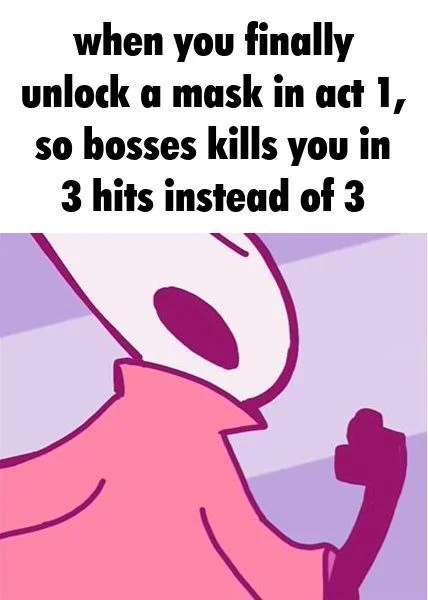
Silksong also creates artificial difficulty from the number of enemies found in each gauntlet or boss arena. For example, Savage Beastfly is a relatively fun and easy fight, but the extra enemies he summons can make the fight a game of luck that will end poorly if he spawns two or more enemies that gang up on you. Broodmother is another fight that capitalizes on sheer numbers of spawned enemies to make the fight harder when the fight would be better if instead Broodmother had more complex attack patterns. There's a reason the High Halls gauntlet is universally hated - throwing 28 enemies in a room is not fun for most players, especially when that room is required to finish Act 2.
As I mentioned above, painful runbacks have somehow continued to persist from Hollow Knight to Silksong. Most people hate fighting the Last Judge and Groal the Great because of the runback: a boss runback adds the unnecessary risk of losing masks and wastes the player's time. In the words of RTGame:
Your life on this Earth is limited. You have limited time and you're going to die someday. I find that when you remind yourself that, "hey, you're going to die someday", you start to not waste time on this shit.
One of best innovations of Elden Ring was its change to completely eliminate runbacks. Most boss arenas in Elden Ring have a site of grace directly outside the boss fog. In Silksong, sometimes the run back to the arena is the hardest part of a fight. A tedious boss runback doesn't improve the satisfaction of a fight and it doesn't make the runback more exciting in another playthrough. It's just artificial difficulty and wasted time.
Lack of Rewards
Another criticism I have of Silksong is its general lack of rewards. When a player defeats a boss, the expectation is to be rewarded for their efforts (gaining a new power, a new tool, or unlocking a brand new area). Unfortunately, most gauntlets, elite enemies, and sometimes bosses don't provide any rewards at all (not even rosaries). This makes it feel pointless to fight some gauntlets or bosses because there is no tangible reward other than bragging rights ("THe ReWaRd Is ThE jOuRNeY"). This is why most people don't do Path of Pain in Hollow Knight. If there's no reward, there's no incentive. I wish there were more unique rewards for defeating bosses or gauntlets.
This issue also applies to crests. When I unlocked my first few crests, I didn't really give them a chance because I learned that all crests deal the same amount of base damage. I now understand that the crests are intended for different attack styles and slightly different bind benefits, but I still wish the crests did more or less damage depending on their effects. In the end I stuck with the default Hunter's Crest because Eva upgrades its base damage.
Unspoken Mechanics
One minor critique I have of Silksong is that a lot of vital gameplay mechanics are never explained to the player. Don't misunderstand me: I don't want those awful info screens or loading screen tips in AAA games telling me obvious information about the game. However, there are important mechanisms that I only understood by looking it up on the internet.

For example, if you get hit while healing, this not only cancels your healing but clears your entire silk bar and damages Hornet. When I first experienced it, I thought this was a glitch because I didn't understand that it was intended behavior. It's a very punishing mechanic that I don't mind existing, but I wish it was explained to me before it happened (or after it happened so I didn't have to look it up).
Another example is that phase cutscenes cancel Hornet's healing. Again, I thought this was a bug until someone explained it to me in chat. It would have been nice to know about this.
There are other examples such as the Magnetite Dice having a small chance to prevent damage, or how consuming 9 plasmium vials gives the player infinite health regeneration. If a player isn't able to know what is possible in the world without explanation, it makes the world harder to understand. At the same time, I understand if Team Cherry wanted Silksong's niche mechanics and combined abilities to be discovered organically by the player themselves so I don't really hold this criticism against them.
Rankings
How can I play a souls-like without providing a boss ranking? This was a really hard decision because all of the bosses have genuinely incredible fights. Here are my favorite bosses:
- Lace (Cradle). It's almost the same as the Lace fight in the Deep Docks but her attacks are quicker and more complex. It's a fast fight that gives you very little time to heal or think. Once you master the fight, it feels like a sword dance.
- Skarrsinger Karmelita. Besides the gauntlet, what makes this fight difficult is that she blocks every other attack you make and punishes you if you attempt to heal on the wall. I love that she attacks faster and more frequently as the fight progresses. You have to be very good at dodging and pogoing to avoid her attacks.
- Trobbio. His fight seems impossible at first because there are so many explosive projectiles and particle effects all over the screen, but over time the patterns become recognizable and his fight becomes very easy. He's a dramatic, funny, and loveable character in both this fight and his second fight.
- Shrine Guardian Seth. His Captain America-like shield-throwing makes the fight a fun game of jumping, dodging, and finding openings.
- First Sinner. This fight is just an upgrade to the Widow fight and kind of reminds me of Grand Mother Silk and the Radiance with pale nails flying across the screen.
- Lost Lace (honorable mention). This fight is a culmination of all other fights, putting all of your skills acquired thus far to the test. It feels like the right amount of difficulty for a final boss and is a really fun fight once you recognize the patterns and discover the openings. Her third phase is nearly identical to her second phase but with more black particles and screen shaking.
- Groal the Great (honorable mention). A lot of people hate this boss but I had a great time after I learned the route and learned the gauntlet enemies. The muckmaggot swamp makes the fight significantly more difficult but it gives the player some openings to kill enemies and regain silk to bind.
- Clover Dancers (honorable mention). This is a pretty easy fight but the controls feel really good when you get into the rhythm of hitting and dodging in quick succession. It reminds me of the Mantis Lords fight from Hollow Knight.
On the other hand, here are my least favorite bosses (ranked from worst to best):
- Every single gauntlet. The gauntlets in this game are excruciating to fight in a tiny enclosed space with 5 enemies (I'm looking at you, Underworks). They're the only thing deterring me from playing Steel Soul mode.
- The Last Judge. This isn't the hardest boss, but it's one of the first bosses that always deals 2 masks of damage when Hornet has 5 masks. If this isn't hard enough, the judge explodes at the very end of the fight and can kill the player if they don't expect it, sending them back to the bench. It's a really awful addition to the fight that could make a calm player rage quit. I luckily avoided this fate when I first defeated the judge because I just happened to have the Fractured Mask equipped.
- Savage Beastfly. This boss is actually very fun to fight when he doesn't summon random enemies to help him. To make matters worse, in the second fight he spawns flying enemies that shoot fireballs that persist on the ground. I cheesed this fight because I didn't even want to bother fighting him properly.
Finally, this is my boss difficulty ranking (ranked from hardest to easiest):
- Skarrsinger Karmelita
- The Last Judge
- Tormented Trobbio
- Lost Lace
- Groal the Great
Tips and Tricks
Silksong can be excruciatingly difficult to play even as a returning Hollow Knight fan. If you're struggling, don't give up! Here are some tips to help you succeed:
- This game is not Hollow Knight. The runbacks are worse, the enemies hit harder, and the parkour is more difficult. Don't try to play the game like you played Hollow Knight. There's a lot of different skills and abilities to master.
- Be aggressive. The enemies in Silksong are aggressive and will not wait for you to heal. It's sometimes better to spam attacks and abilities when given the opportunity.
- Use the tools the game provides. The gameplay is designed with tools and abilities in mind, so it's not wrong to use them.
- Explore. There's so many powerful upgrades and abilities hidden throughout the maps. If you're struggling on a boss, try exploring other areas first.
- Take your time. No one is rushing you to complete the game (I finished the game 5 months after starting it). You can spend as long as you want to explore the map, defeat all bosses and reach the ending.
Memes
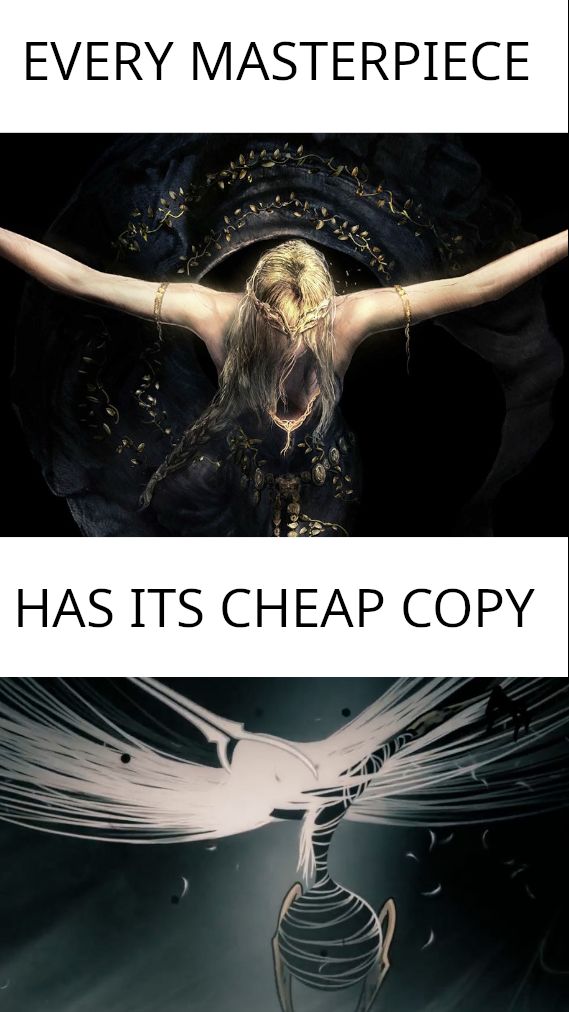
Memes are an iconic part of the Silksong experience. Here are some of my favorite memes.
view memes
Imaginary Technique: Purple Cogfly
Conclusion
I give Hollow Knight: Silksong a 7.8/10 for its incredible mechanics, visuals, music, and story. Although this is an extremely punishing game with glaring flaws, it's well worth it to keep playing and stick around until the end. It is by no means a perfect game, but it has earned its place as one of my favorite games of all time. I'm very happy with my first playthrough and I'm excited to see future content from Team Cherry.
It took me an embarrassingly long time to gather my thoughts and write this. It's frankly impossible to sum up nine whole years of game development into a single text review such as this one. There's so many layers that just can't be summarized, and I left a numerical rating... as if a number can be assigned to such a complicated piece of art.
Just go play this game for yourself.
Parallax is when objects further in the background appear to move slower than objects closer to the foreground. It's an effect that mimics real life movement. Imagine you're on a roadtrip: as you drive, houses and mountains on the horizon appear to move more slowly than the houses and cars next to you. ↩︎
A gauntlet is a challenge room in which the player must defeat a large number of enemies (usually in waves) to proceed to the next room or area. There are too many gauntlets in Silksong. ↩︎
Cheesing an enemy in a game means using your knowledge of the enemy's attack patterns and location to completely trivialize the fight, often making it so you don't have to fight the enemy at all. For example, there's plenty of ways people have learned to cheese the Capra Demon boss in Dark Souls. ↩︎